Compliance
PCI DSS 4.0 penetration testing: requirement 11.4 explained
Requirement 11.4 is short. Each line of it decides what your tester must do and what your assessor will ask to see.
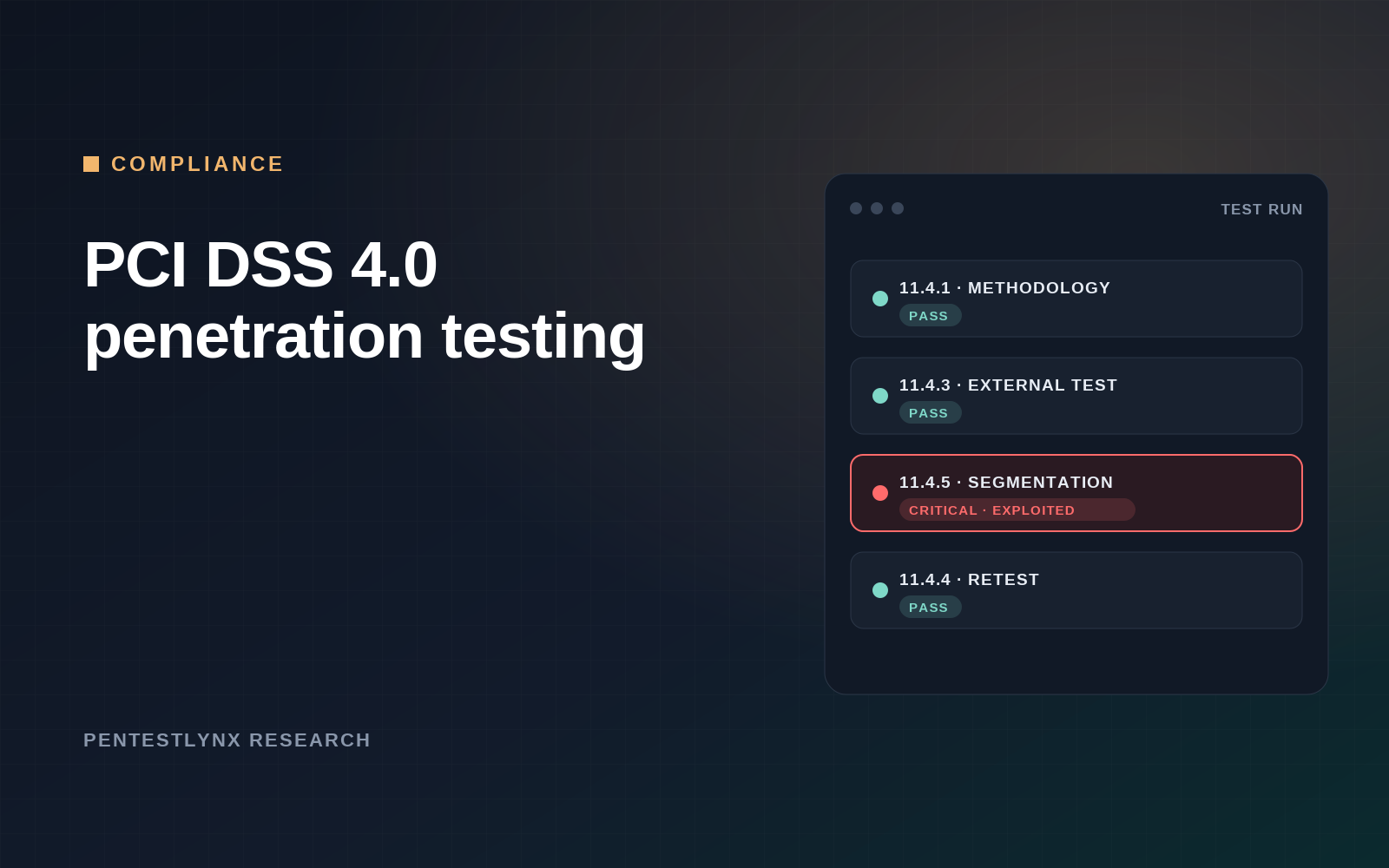
If you store, process or transmit card data, or can affect the security of systems that do, PCI DSS applies to you, and requirement 11.4 tells you how to pentest. It is one of the most specific pentest rules in any compliance framework. This guide walks through each sub-requirement of 11.4 in PCI DSS v4.0.1, what it means in practice, and what your assessor will ask to see.
We base the details below on Software Secured's summary of the standard. Always check the wording in the PCI DSS document itself, available from the PCI Security Standards Council, before you rely on it for an assessment.
Source: Software Secured, PCI DSS pentesting guide
Which version applies
PCI DSS v3.2.1 was retired on 31 March 2024 and v4.0 on 31 December 2024, leaving v4.0.1 as the current version. The requirements that v4.0 marked as "future-dated" became mandatory on 31 March 2025. If your last assessment was under v3.2.1, expect your next one to ask for more.
Source: Software Secured, PCI DSS pentesting guide
11.4.1: A documented methodology
You need a written penetration testing methodology, defined and approved by your organisation. According to Software Secured's summary, it should:
- follow an industry-accepted approach, such as NIST SP 800-115, the OWASP testing guides, PTES or OSSTMM;
- cover the entire perimeter of the cardholder data environment (CDE) and critical systems, from both inside and outside the network;
- describe how exploitable findings are ranked by risk and corrected.
The standard itself lists further elements, including application-layer testing and segmentation testing, so compare your methodology with the full wording of 11.4.1.
Test results must be kept for at least 12 months. In practice, assessors ask for the methodology document, the last two reports and evidence that findings were handled.
11.4.2: Internal penetration testing
An internal test at least once every 12 months and after any significant infrastructure or application upgrade or change. It must be done by a qualified tester who is organisationally independent of the systems being tested: not the team that manages them.
Our analysis: "significant change" is where many companies get caught. A new payment flow, a new API exposed to the CDE, a cloud migration or a major rewrite usually counts. Decide your own definition in writing before the assessor asks.
11.4.3: External penetration testing
The same rules from outside: at least every 12 months and after significant change, by a qualified, independent tester. For most SaaS and e-commerce companies, the external test is where the web application and its APIs are tested, so it needs to include authenticated application testing, not just a scan of open ports.
11.4.4: Fix and retest
Exploitable vulnerabilities and security weaknesses found during testing must be corrected according to your risk ranking, and the test repeated to confirm the fix. Assessors look for the retest evidence. A report full of open critical findings with no retest is a problem; a report with findings that were fixed and verified is normal and fine.
11.4.5: Segmentation testing
If you use segmentation to reduce PCI scope, for example by keeping the CDE in its own network or cloud account, you must test that segmentation at least every 12 months and after any change to segmentation controls. The test has to show that out-of-scope systems really cannot reach the CDE.
Segmentation is often where the largest scope reduction comes from, so it is also where a failed test hurts most: if segmentation fails, systems you treated as out of scope come back in.
11.4.6: Extra rules for service providers
If you are a service provider, segmentation testing is required at least every six months and after changes to segmentation controls. Payment platforms, payment-facing SaaS and hosting providers often fall into this category.
11.4.7: Multi-tenant service providers
Multi-tenant service providers must support customers who need to run external penetration tests of their own segment under 11.4.3.
What your assessor will want to see
- The written methodology, with a named standard.
- Internal and external reports from the last 12 months, with scope, dates and tester qualifications.
- Segmentation test results, if you rely on segmentation.
- Evidence that exploitable findings were fixed and retested.
- Evidence of tests after significant changes, or a record of why a change was not significant.
- For service providers, six-monthly segmentation tests.
Common gaps
- A scan presented as a pentest. Automated vulnerability scans, including quarterly external scans by an Approved Scanning Vendor, fall under requirement 11.3. They do not satisfy 11.4.
- No application-layer testing. An external test that only checks ports and TLS misses the web app, where card data is actually handled.
- No retest. Findings fixed but never verified.
- Missed "significant change" tests. A big release went live between annual tests.
- Tester independence unclear. A developer testing their own system does not meet the requirement.
A practical plan
Run a full internal and external test once a year, aligned with your assessment cycle. Add a focused application test after each significant change to anything in or connected to the CDE. Keep each report, its retest and a short note mapping findings to 11.4 sub-requirements in one folder for your assessor.
We run the application-layer part of this with AI agents that exploit and prove each finding, and senior pentesters review the work, sign the report and handle the retest. That makes testing after each significant change practical rather than something you postpone to the annual cycle.
Frequently asked questions
How often does PCI DSS require a penetration test?
Internal and external tests at least once every 12 months and after significant changes. Segmentation tests every 12 months, or every six months for service providers.
Does an ASV scan count as a PCI pentest?
No. Vulnerability scans fall under requirement 11.3. Requirement 11.4 asks for penetration testing by a qualified, independent tester.
Who can perform a PCI DSS penetration test?
A qualified tester who is organisationally independent of the systems being tested. It can be an internal team or an external firm, as long as it is not the team that manages the environment.
See what an attacker would find in your app
Our AI agents attack your web app or API with your permission, prove each finding with a working exploit, and senior pentesters review and sign the report.